Ethics · Cultural · November 2025 · 11 min
Microsoft: ADLaM — an alphabet to preserve a culture
A long-term Microsoft partnership digitised a script created by two teenage brothers — a blueprint for ethical, infrastructural marketing, and a cautionary tale about platform dependency.

In an era of global connectivity, digital platforms hold immense power to either amplify or erase cultural diversity. This places a critical responsibility on technology companies and marketers to consider their ethical obligations, raising the question: in what ways can marketing and digital communications be 'ethical'? This essay will explore this question by providing a balanced, critical analysis of Microsoft's ADLaM campaign, a long-term initiative to digitise and distribute a modern writing system for the Fulani people of West Africa. This campaign serves as a powerful case study of corporate intervention in cultural preservation, offering both a potential model for ethical practice and a cautionary tale about its inherent complexities. This essay will explore the PESTLE context of the campaign, the background of the Fulani people and the ADLaM script, the marketing and digital communications tactics used, and a balanced ethical critique before concluding with specific, evidence-based findings on what constitutes ethical practice in this domain.
Understanding the Environment
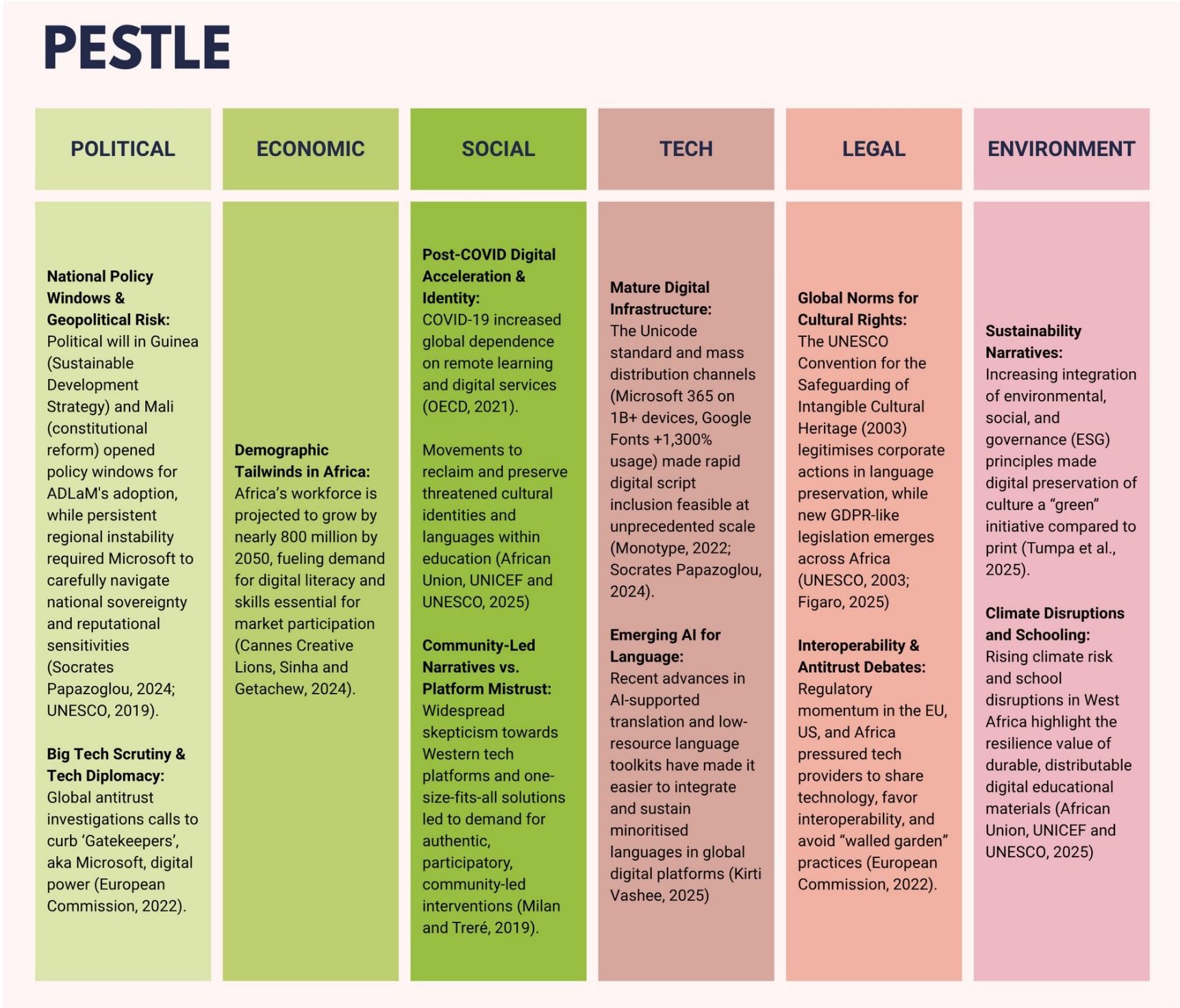
The ADLaM campaign was influenced by several factors outside Microsoft's control (see Figure 4). Politically, policies in Guinea and Mali opened doors for language education, and rising scrutiny of Big Tech made visible social impact more important (Socrates Papazoglou, 2024; Cannes Creative Lions, 2024; Couldry & Mejias, 2019). Economically, rapid urban growth made digital literacy more urgent, so distributing the script through widely used platforms worked better than traditional campaigns (Sinha and Getachew, 2024; Socrates Papazoglou, 2024).
Socially, the shift to online learning after COVID-19 strengthened efforts to protect cultural identity, with community sharing (including #ADLaMRe) helping adoption (Cannes Creative Lions, 2024). Technologically, being in Unicode and available through Microsoft 365 and Google Fonts put the script on over a billion devices and contributed to a reported 1,300% rise in weekly use (Monotype, 2022; Socrates Papazoglou, 2024).
Legally, UNESCO's frameworks encouraged cultural preservation, and open licensing plus data protection supported fair access (UNESCO, n.d.; Floridi & Cowls, 2019). Environmentally, digital delivery made learning materials more resilient to climate disruption and reduced reliance on print (Socrates Papazoglou, 2024). Together, these factors shaped how the campaign was delivered and what could be achieved, setting the stage for ADLaM to be more than a promotional initiative.
A useful comparative precedent is the Cherokee syllabary. Created by Sequoyah in the 1820s, it risked decline until its inclusion in Unicode and support across mainstream operating systems, which enabled everyday digital use and strengthened revitalisation efforts (Lock and Gers, 2017). The Cherokee case underlines two lessons directly relevant to ADLaM: that digital access is now a precondition for cultural resilience, and that long-term success depends on community-led governance of the script's digital standards and distribution.
The Fulani are one of the largest and most widespread nomadic groups in the world, with a population estimated at over 60 million people across West Africa and the global community (Socrates Papazoglou, 2024). Their native language, Pulaar, has been spoken for centuries but lacked a dedicated alphabet. Historically, knowledge was passed down through a rich oral tradition, but this made the culture vulnerable to assimilation and disappearance. In 1989, two teenage brothers, Ibrahima and Abdoulaye Barry, decided to solve this problem. They painstakingly created a new alphabet designed specifically for the sounds of the Pulaar language. They named it ADLaM, an acronym for a Pulaar phrase that translates to 'the alphabet that will prevent a people from disappearing' (Microsoft, 2022). Their life's work was dedicated to teaching ADLaM, but achieving widespread adoption required overcoming the final hurdle: bringing it into the digital age.
Campaign Analysis
Microsoft's involvement was not a conventional advertising campaign but a long-term, multi-faceted partnership delivered through strategic marketing and digital communications. The approach prioritised utility and access over persuasion. A core tactic was using the product itself as the primary media channel. By embedding ADLaM Display as a standard font across its Microsoft 365 suite, the script was delivered to over one billion devices by default, making it a permanent piece of digital infrastructure (Socrates Papazoglou, 2024).
The campaign embraced open distribution. Microsoft shared the font for inclusion in Google Fonts, an act of interoperability associated with a rise in weekly serves from 213,000 to over 2.13 million (Socrates Papazoglou, 2024). Longer-form storytelling on corporate platforms, combined with social seeding by the Barry brothers and diaspora communities, drove earned attention and organic adoption. Crucially, the focus was on education-first materials. The partnership created and distributed printed primers, books, and posters for use in community schools, directly supporting literacy rather than just brand exposure (See figure 5).
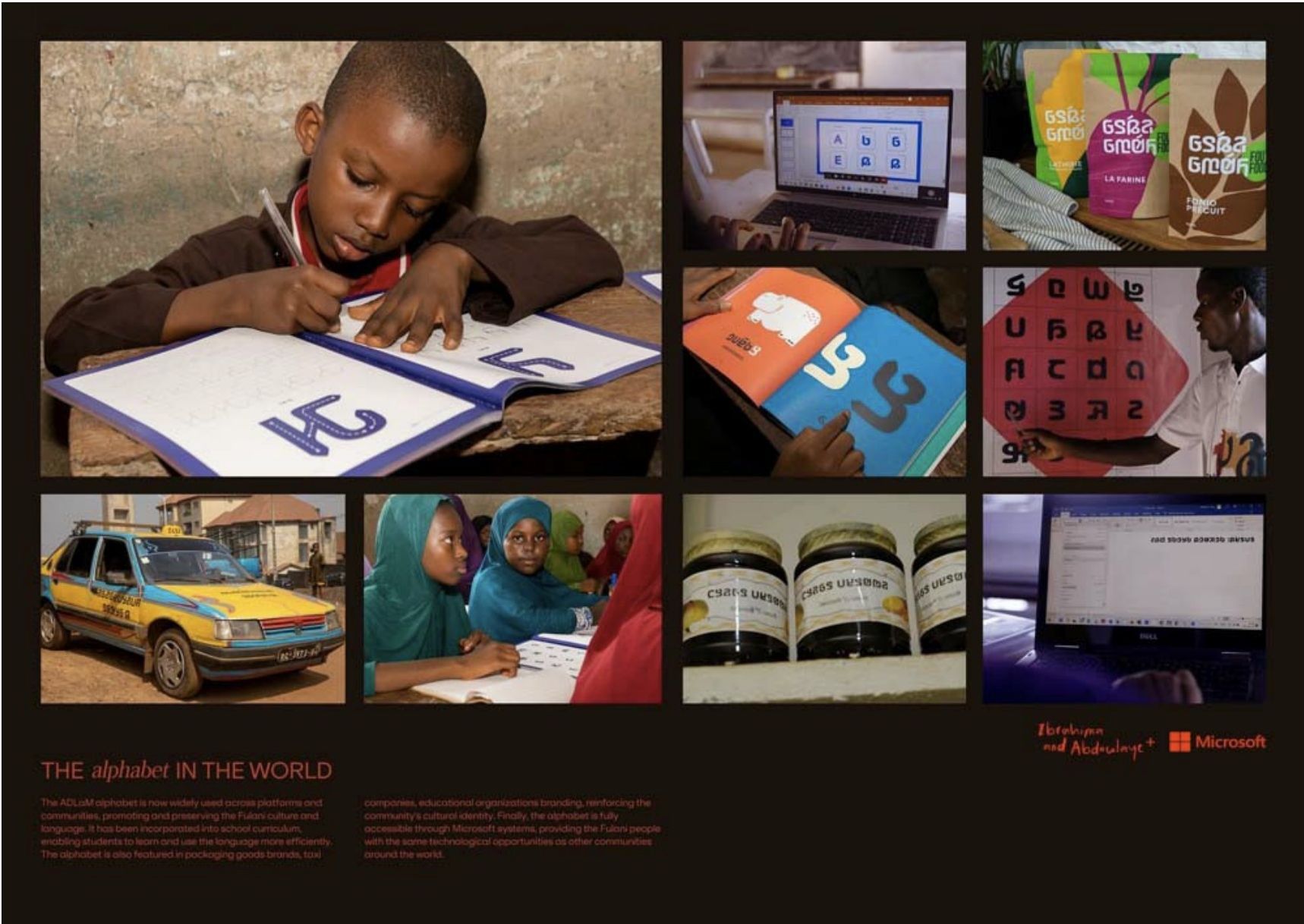
Community co-creation extended into everyday use, with users contributing to the first Pulaar dictionary via #ADLaMRe, strengthening legitimacy and uptake. Reported results included an additional 30,000 students learning ADLaM in the first four months and the establishment of new schools in Guinea, Sierra Leone, and Gambia (Socrates Papazoglou, 2024). Policy shifts followed, with Guinea integrating ADLaM into its development strategy for two million students and Mali moving towards constitutional recognition (Socrates Papazoglou, 2024; Cannes Creative Lions, 2024).
Ethical Analysis
On one hand, the campaign is a clear example of community-centred ethical practice in action. It aligns with the capability approach, a social-ethical framework that measures progress by how much people's real freedoms expand (Sen, 2001). By offering literacy tools, Microsoft helped enhance core social capabilities that support dignity, agency and equitable access to opportunity (Nussbaum, 2013). The participatory approach, working through community leaders, reflects commitments to respect, inclusion and self-determination (Couldry & Mejias, 2019; Milan & Treré, 2019). The campaign's delivery also demonstrates sound ethical judgement. Prioritising open access and interoperability reduced structural barriers and broadened participation, advancing social justice. Emphasising practical skills and education signals a commitment to delivering measurable, tangible benefits while minimising unintended harms. These choices align with the classical principles of beneficence, non-maleficence, justice and autonomy, traditionally applied in bioethics, as adapted to digital ethics in technology and marketing contexts (Floridi & Cowls, 2019). The work also supports UNESCO's mission to safeguard intangible cultural heritage (UNESCO, 2003).
On the other hand, a more critical view could argue there is a case for 'ethics washing', where a company runs a socially positive project to build goodwill while diverting attention from less ethical practices (Greene, Hoffmann & Stark, 2019). While this does not undermine the campaign's positive contributions, it highlights the importance of scrutinising corporate motives and long-term impact. Microsoft is currently subject to legal and reputational scrutiny related to AI practices, ranging from copyright litigation brought by The New York Times to regulatory allegations concerning AI-related pricing and bundling (Gordon, 2023; McGuire, 2025). In this climate, concerns about 'ethics washing' may be amplified. Even with open fonts, relying on a few large platforms for distribution can create power imbalances around updates, discovery and access (Couldry & Mejias, 2019; Milan & Treré, 2019). As with Cherokee, ADLaM's future vitality will hinge on device-independent access and community control over updates and standards. Ultimately, sustainable ethical outcomes will depend on community-led governance of ADLaM's digital evolution, ensuring local agency and autonomy remain central.
Effectiveness and Critique
The campaign's primary strength was its focus on building permanent infrastructure rather than ephemeral messaging. By embedding the font, partnering with educators, and influencing policy, it created lasting, systemic change. The open-source strategy was a key mitigating factor against charges of corporate capture, as it ensured the asset was not exclusive to Microsoft's ecosystem.
However, its limitations are equally significant. The project's long-term governance remains undefined. Without a clear plan for a community-led oversight board, stewardship of the script's digital future rests implicitly with corporations. Measurement is another weakness; font usage statistics do not equate to literacy or cultural vitality. To be truly effective, the project requires longitudinal metrics on educational attainment and the creation of new ADLaM content. Practical mitigations for these risks include establishing an independent community board to govern the script's evolution, creating open specifications for keyboards and input methods to ensure multi-vendor support, and funding independent research to track long-term societal impact.
Conclusion
Microsoft's ADLaM campaign provides a nuanced answer to the question of how marketing and digital communications can be ethical. It demonstrates that ethical practice is achievable through several concrete actions:
- Transparent Intent: Prioritising a clear social good, such as cultural preservation and access to education, over direct commercial goals.
- Product as Medium: Using a product or service to provide tangible, lasting value rather than relying on persuasive advertising.
- Openness and Interoperability: Committing to open standards and cross-platform availability to ensure equitable access and prevent proprietary lock-in.
- Participatory Representation: Ceding creative control to the community being represented, ensuring their voice, leadership, and ownership are central.
- Community Governance: Community-led oversight for standards, input methods, and maintenance, supported by clear reporting.
- Permanence as Infrastructure: Focusing on creating durable systems and infrastructure that outlive a campaign cycle.
- Accountable Metrics: Measuring success based on real-world impact, such as educational uptake and policy change, rather than vanity metrics.
While the ADLaM initiative is not without risks, particularly concerning long-term governance and platform dependency, its delivery model offers a compelling blueprint. It suggests that ethical marketing is not about avoiding commercial realities, but about aligning them with genuine human needs in a way that is just, respectful, and supportive of agency and self-determination. The project's ultimate success will depend on whether its partners fully commit to ensuring the Fulani people are not just users of this new digital tool, but sovereign authors of their own digital future.
— Bex Sutton