Ethics · Public sector · November 2025 · 10 min
Mayor of London: Maaate — ethics, future-proofing and a one-word intervention
How a single conversational prompt was engineered as a long-term social tool — and what it shows about ethical public-sector communication.

This essay explores how marketing and digital communications can be ethical and sustainable through the case of the Mayor of London's 'Maaate' campaign (Mayor of London, 2023). The campaign addresses male behaviour and misogyny by encouraging men and boys to intervene when peers 'cross the line,' using the colloquial prompt 'maaate.' This study analyses how the campaign's creative and ethical design supports long-term social change, making it an example of future-proofed public communications.
In a period marked by digital toxicity, male loneliness, and declining social empathy (Campaign to End Loneliness, 2023; Badham, 2025), the Maaate campaign demonstrates how government communication can rebuild social trust. Using a PESTLE analysis, ethical marketing frameworks, and comparison with the Department for Transport's 'See It, Say It, Sorted', the essay evaluates how Maaate both reflects and anticipates future audience expectations. It concludes by considering how the campaign's ethical foundation, tone, and strategy contribute to London's evolving social resilience and political credibility.
Understanding the Environment
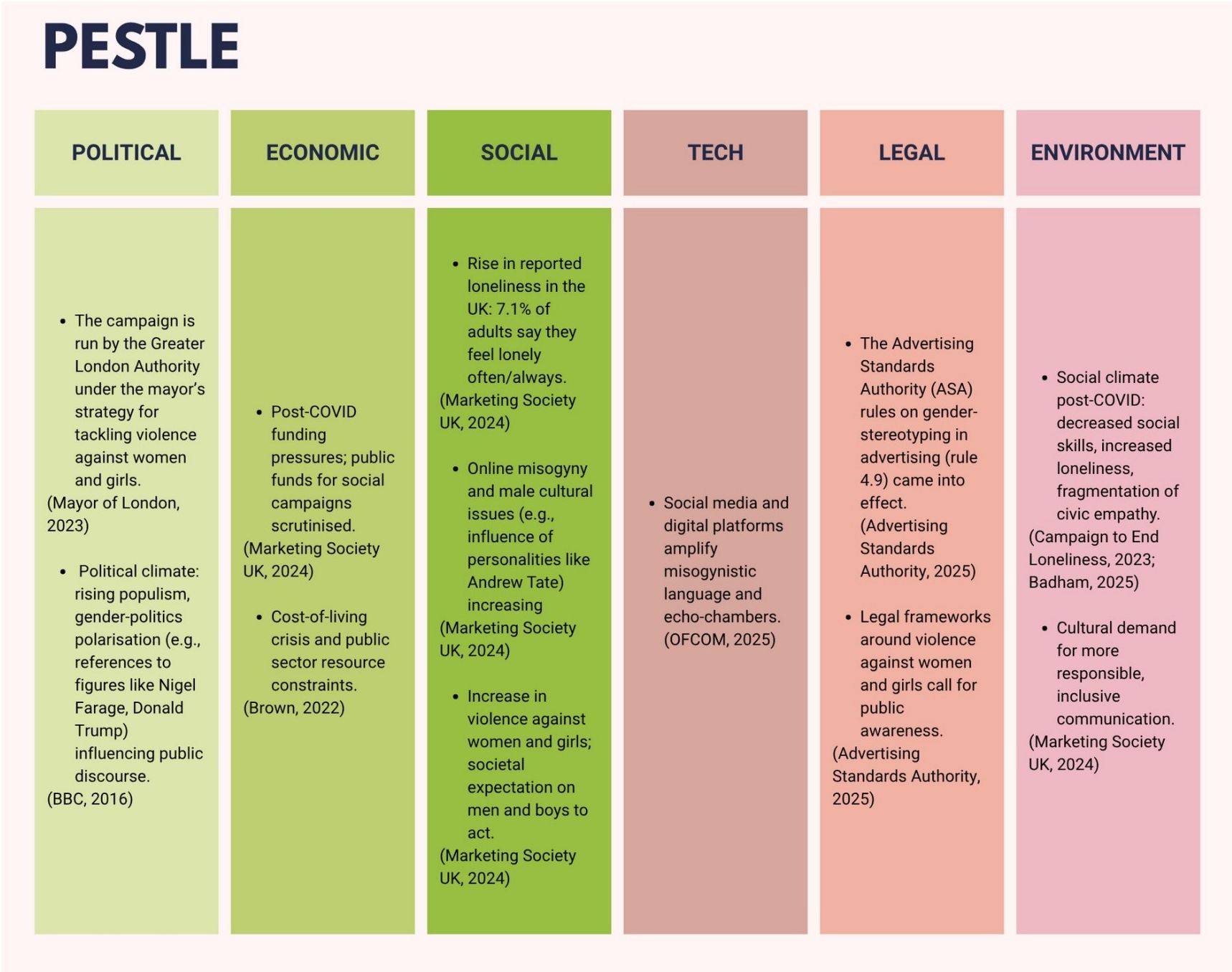
To be ethical and future-proof, a campaign must be built on a deep understanding of its operating environment, as figure 6 outlines. Politically, the Maaate campaign was launched under the Mayor of London's strategy for tackling violence against women and girls (VAWG), positioning it as a core civic priority (Mayor of London, 2023). It navigated a polarised climate in which figures such as Donald Trump made lewd public remarks about women, which were defended and normalised in the UK by Nigel Farage, intensifying contentious discourse around masculine behaviour (BBC, 2016). Economically, post-COVID pressures on public funds meant the campaign had to demonstrate significant value and impact on a modest budget of £219,143 (AME Awards, 2024).
Socially, the context was defined by a series of interconnected crises. The murder of Sarah Everard by a serving police officer in 2021 shattered public trust and highlighted how 'low-level' misogynistic language often precedes violence (Marketing Society UK, 2024). This occurred alongside a rise in reported loneliness, with 7.1% of UK adults feeling lonely often or always, a condition exacerbated by a post-COVID decline in social skills (Campaign to End Loneliness, 2023; The British Academy, 2021). Simultaneously, the digital influence of misogynistic personalities like Andrew Tate grew, with one survey showing 35% of young British men agreed with his rhetoric (Marketing Society UK, 2024). This toxic combination created a pressing need for an intervention that could equip men to act.
Technologically, the campaign had to operate within digital platforms that often amplify misogynistic echo chambers (OFCOM, 2025). Legally, it was bound by Advertising Standards Authority (ASA) rules on harmful gender stereotyping, demanding a nuanced approach (Advertising Standards Authority, 2025). Culturally, it sought to restore a sense of civic empathy and social responsibility eroded by years of polarisation and pandemic-induced isolation. This challenging environment demanded not just a campaign, but a carefully designed social tool that was credible, accessible, and built for long-term cultural change.
Ethical Marketing and Communicative Future-Proofing
Ethical marketing in the public sector moves beyond persuasion to cultivate social good, balancing stakeholder needs with a duty of care (Kotler and Armstrong, 2018, pp.617–621). The Maaate campaign exemplifies this through its alignment with established ethical frameworks. Habermas' (1984) theory of communicative ethics, which prioritises open, rational dialogue to achieve moral legitimacy, is central to the campaign's design. Rather than issuing a top-down directive, Maaate provides a conversational tool, a single word, that invites peer-to-peer reflection and self-regulation. This non-authoritarian approach reduces defensiveness and creates space for authentic dialogue, a cornerstone of future-proofed ethics.
This is complemented by Kotler and Armstrong (2018) Principles in Marketing views on marketing ethics, which outline 6 core values, 'honesty, responsibility, fairness, respect, transparency, and citizenship'. The campaign's strategy was to 'Break the silence, not the social bond' (Marketing Society UK, 2024). By framing intervention as an act of friendship and respect, it invests in men's emotional education and their capacity to care for one another's behaviour. This nurtures a culture of accountability that can extend beyond the campaign's lifespan.
As a precedent for long-term behavioural change, the Department for Transport's 'See It, Say It, Sorted' (GOV.UK, 2025b) demonstrates how a simple, consistent message can embed a new norm into public consciousness. Its success lies in making a civic duty memorable and actionable. Similarly, Maaate aims for linguistic permanence by turning a common word into a simple way to talk about accountability. Giving people a shared word like this helps make the idea of allyship a normal part of everyday masculinity for future generations.
Campaign Analysis and Critique
The campaign's primary strength was its evidence-led diagnosis of the problem. Research revealed that while 85% of men were motivated to challenge misogyny, two-thirds felt they lacked the capability (Marketing Society UK, 2024). Drawing on the COM-B behaviour change model referenced in the AME Awards case study, the campaign focused on addressing this 'capability' gap rather than motivation or opportunity (AME Awards, 2024). The chosen tool, the word 'Maaate', was developed through ethnographic research and validated for its ability to balance levity and seriousness, using techniques like vowel lengthening to signal disapproval without aggression (Chester, 2025).
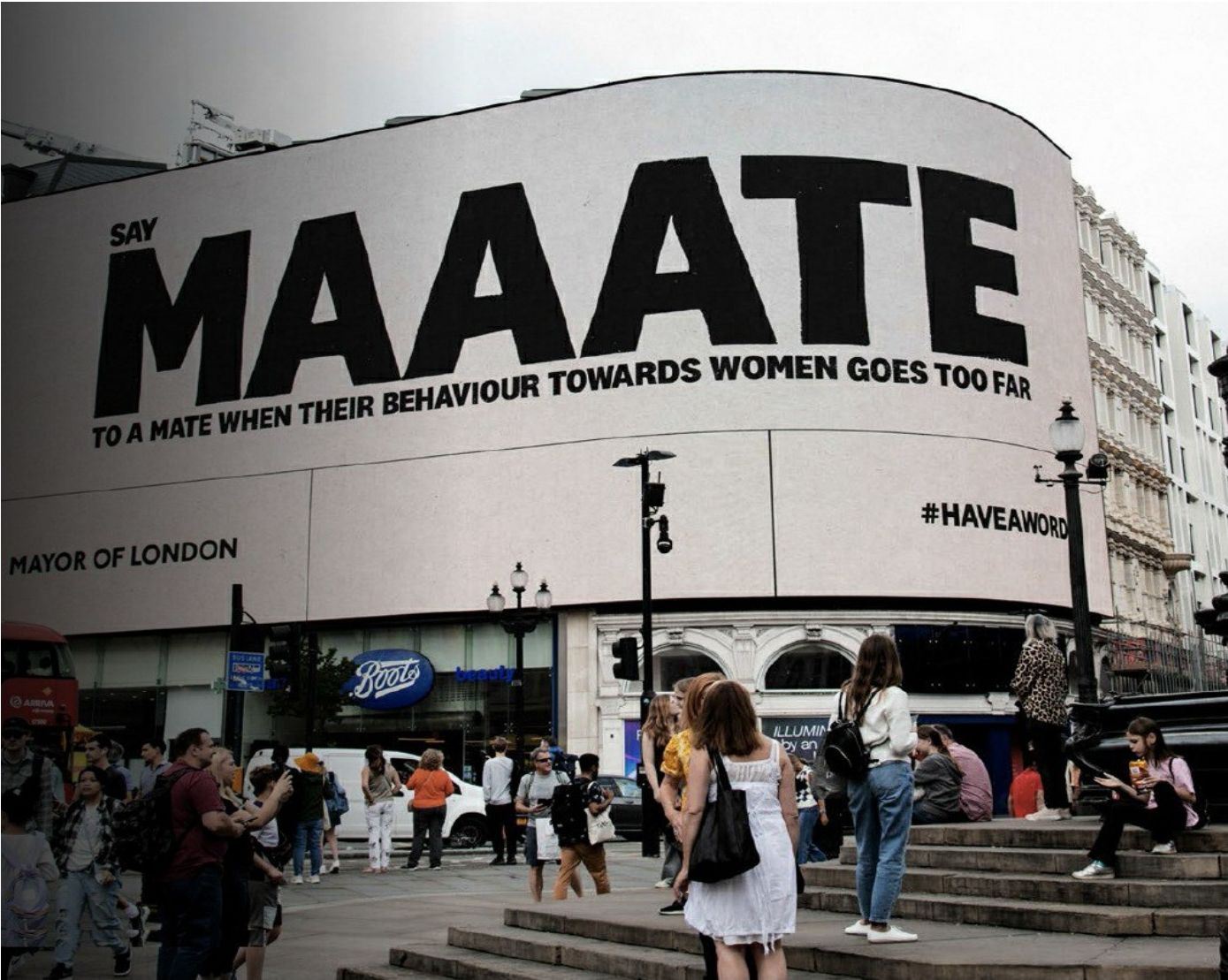
Its implementation was equally sophisticated. Drawing on network science, the campaign used a 'social-credibility-first model' to spread the behaviour as a 'complex contagion' (Chester, 2025). Instead of launching with the Mayor's official endorsement, it was seeded into culture via credible messengers like comedian Romesh Ranganathan and LADbible's creator network. This built organic momentum before the official launch, which included an interactive film by 'Top Boy' director Koby Adom, fly-poster style OOH, and a GIF for private chats (Chester, 2025).
The results were substantial. The campaign generated an earned media reach of 3.5 billion (double that of the FIFA World Cup) and accounted for 43% of the UK conversation around tackling misogyny in 2023 (AME Awards, 2024). Crucially, it shifted behaviour among its target audience of 18-34-year-old men. Confidence to intervene rose from 38% to 54%, and willingness to intervene increased from 73% to 81%, turning them from the least likely demographic to intervene into the most likely (Marketing Society UK, 2024). Of those who had intervened, nearly half (48%) reported using 'Maaate' to do so (AME Awards, 2024). By successfully addressing a major social issue, the campaign also future-proofed the Mayor of London's reputation, positioning the office as progressive, empathetic, and effective.
However, the campaign isn't perfect. Using humour and a casual, friendly tone could make the serious issue of violence against women (VAWG) seem less important if people see it as just entertainment rather than a prompt to think and act (Nabi, Moyer-Gusé & Byrne, 2007). Also, the mainstream style might not connect with all groups of men, especially those influenced by extreme online communities (Ofcom, 2023). To stay relevant, the campaign needs to keep adapting and stay inclusive. The biggest challenge is measuring real impact, while engagement numbers are high, showing lasting changes in behaviour and attitudes requires long-term evaluation. Without this, it's hard to know whether the campaign will have a meaningful, lasting effect.
Future-Proofing as Ethical Practice
To be truly ethical, a public information campaign must be designed for sustainability. Maaate's future-proofing is built into its core strategy. By creating a new lexicon for positive masculinity, it provides a cultural asset that can be passed down and adapted by future generations. Its focus on addressing root causes, a lack of confidence and tools for intervention, rather than just surface behaviours gives it enduring relevance.
The campaign's most tangible future-proofing mechanism is its institutionalisation. The 'Maaate' concept and a supporting toolkit have been embedded into the curriculum of every secondary school in London (AME Awards, 2024). The London College of Policing is also using it as a case study to help officers call out inappropriate behaviour internally (AME Awards, 2024). These steps transform the campaign from a fleeting media moment into a permanent part of London's educational and institutional infrastructure, ensuring its ethical message continues to shape behaviour long-term.
For the campaign to leave a lasting impact, it must continue to evolve. Ongoing evaluation is crucial to track changes in attitudes and identify any unintended consequences. Future iterations should engage more closely with community groups to ensure the message remains inclusive and resonates across diverse male audiences. By maintaining transparency, responsiveness, and a commitment to long-term data collection, the campaign can demonstrate enduring social value and serve as a robust, ethical model for public communication.
Conclusion
Ethical marketing is not a fixed state but an adaptive process demanding empathy, responsibility, and a commitment to long-term social benefit. The Mayor of London's Maaate campaign demonstrates how public communications can meet this standard by being strategically future-proofed. By engaging men with authenticity and humour, it successfully reframes intervention not as confrontation but as an act of care, catalysing a vital shift towards a more relational and accountable masculinity.
While it faces risks around trivialisation and inclusivity, its foundational design was built on deep research, ethical theory, and a sophisticated seeding strategy and has delivered measurable shifts in attitudes and behaviours. Its lasting impact, however, will be determined by its successful integration into London's schools and policing, transforming a communications initiative into a cultural norm. Ultimately, Maaate proves that the most ethical marketing does not just address the challenges of today; it equips society with the language and capability to build a better tomorrow.
— Bex Sutton